


Let’s be honest: if your product roadmap looks like a never-ending grocery list written under the pressure of your biggest clients or year-end technical constraints, you have a trajectory problem. Whether you are scaling a hyper-growth SaaS startup or modernizing a deep-rooted legacy software (ERP, industrial systems, or business tools), a roadmap isn't a mere catalog of technical "promises." It is the bridge between your strategic vision and the actual experience of your users. At merveilleUX, we too often see teams exhausted from shipping modules that no one uses, simply due to a lack of methodology. Here is how to take back control of your product, whether it’s 2 months or 20 years old.
Table of contents
- What is a Product Roadmap? (Definition and Strategic Challenges)
- Why the Product Roadmap is the Pillar of Your Growth
- Who is the Product Roadmap For?
- How to Build an Effective Product Roadmap in 7 Steps
- Deep Dive: Prioritization Frameworks in Detail
- Pitfalls to Avoid (Or How Not to Sabotage Your Growth)
- Roadmap Management Tools: 2025 Comparison
- The Impact of UX Design on Your Roadmap
- Conclusion
What is a Product Roadmap? (Definition and Strategic Challenges)
Definition and Benefits of a Roadmap for SaaS Startups and Business Software
A product roadmap is a living strategic document. It communicates the "why" and the "what" behind what you are building. It’s not a technical document for developers, but an alignment tool that synchronizes Product, Design, Engineering, Marketing, and Sales around a common direction.
For a growth-stage startup (Series A or B), it provides major structural advantages:
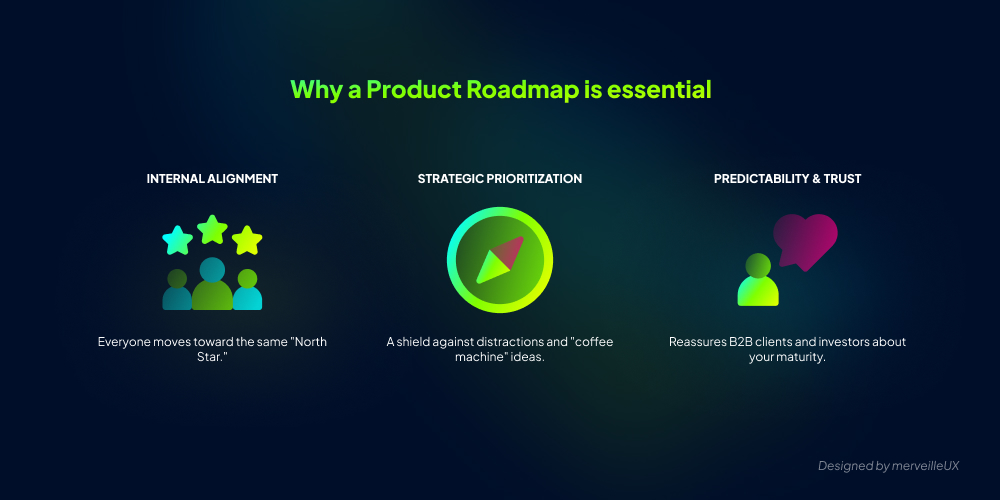
- Internal Alignment (The North Star): It prevents departments from pulling in different directions. Everyone knows which peak we’re climbing and why.
- Strategic Prioritization: It acts as your shield against "genius ideas" that pop up at the coffee machine. It allows you to say "no" (or "not now") to distractions to stay focused on impact.
- Predictability and Trust: It reassures customers (especially in B2B) about the product's longevity and gives investors proof of your strategic maturity.
What a Product Roadmap is NOT
Be careful of misconceptions—this is often where things go wrong. A roadmap is not:
- A glorified backlog: The backlog is a granular list of tasks and Jira tickets. The roadmap is a macroscopic overview. If you’re putting ticket numbers in it, you’ve already lost.
- A frozen contractual commitment: In an uncertain environment, committing to a specific feature 18 months in advance is industrial suicide. The roadmap should promise solutions to problems, not immutable delivery dates.
- A giant Gantt chart: If your roadmap looks like a construction site with cross-dependencies everywhere, you’re doing project management, not product strategy. Agility requires flexibility.
The Difference Between Vision, Strategy, and Roadmap
To build correctly, you need to know where you stand:
- Vision: This is your final destination, your WHY. (e.g., "Making payroll management as easy as sending a text message").
- Strategy: This is your game plan. Which markets to attack? Which types of users to prioritize? (e.g., "Targeting SMEs with 10 to 50 employees with a focus on automation").
- Roadmap: This is the temporal execution of that strategy. Which problems are we solving first?
Without a solid UX, this roadmap remains an abstract theory. It’s the interface and the user journey that make the strategy tangible and effective.
Why the Product Roadmap is the Pillar of Your Growth
What are the Objectives of a Product Roadmap?
A well-designed roadmap doesn't just aim to "ship stuff." It seeks to achieve concrete Outcomes (business results):
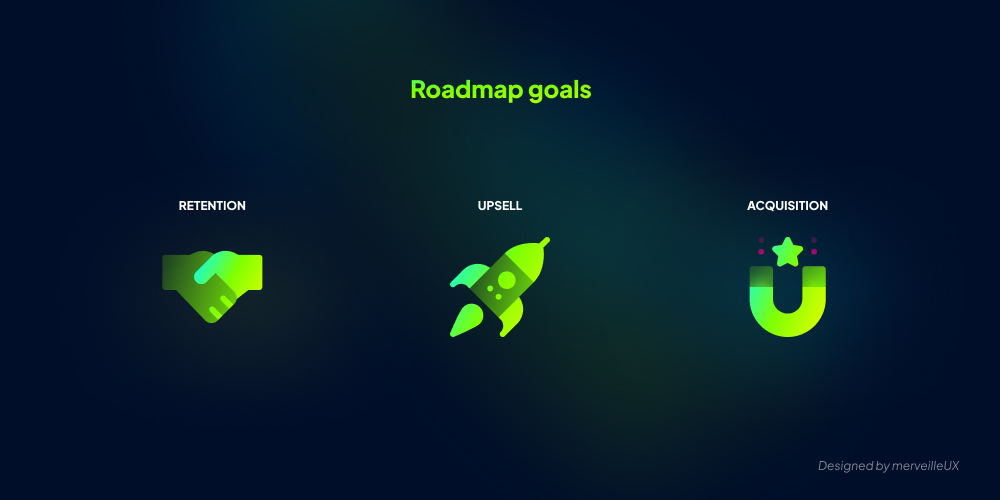
- Retention (Anti-Churn): Identifying friction points in the user journey that cause users to leave the app out of frustration.
- Expansion (Upsell): Adding value blocks that will allow users to move from a Standard plan to an Enterprise plan.
- Acquisition: Developing "must-have" features to unlock new market segments.
Product Roadmap and Agile Methodology: Why Combine Them?
Agility allows you to test hypotheses quickly. Your roadmap must therefore be "alive."
- Agility without a roadmap: Is like flying blind. You release patches and iterate, but you don’t know if you’re building a coherent product or something useless.
- Roadmap without agility: Is the "tunnel effect." You lock yourself away for 6 months to release a feature that the market no longer needs.
The winning duo? A roadmap that defines themes (problems to solve) and an agile method that defines how to solve them based on ongoing user testing.
Who is the Product Roadmap For?
Who is Responsible for the Roadmap?
In a mature company, this is traditionally the domain of the CPO (Chief Product Officer) or the Product Manager. However, at merveilleUX, we advocate for a collaborative approach:
- The PM brings market data and business objectives.
- The Product Designer brings the voice of the user and ergonomic feasibility.
- The CTO brings technical viability and prevents technical debt.
In a "Classic" or "Legacy" software company (SMEs, business software), startup jargon can be irritating when you've been managing complex systems for years. In reality, the roadmap is driven by:
- The R&D Manager or CTO: They carry the vision for the structural evolution of the tool and manage technical obsolescence.
- The Functional Project Manager: They know your customers' businesses by heart (accounting, logistics, HR) and translate their needs into evolutions.
- The Sales/Marketing Director: They know what’s blocking sales today and what will get customers to sign tomorrow.
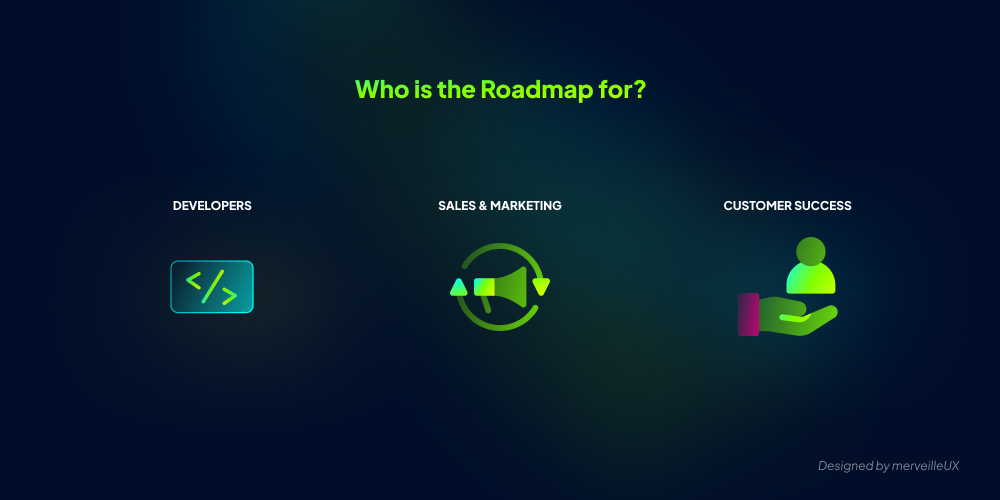
Which Teams Use the Roadmap?
- Developers: To understand the purpose of their code and anticipate infrastructure projects.
- Sales & Marketing: To prepare launches, communication campaigns, and provide visibility to prospects.
- Customer Success: To give perspective to unhappy customers and know which support requests will be resolved soon.
How to Build an Effective Product Roadmap in 7 Steps
Step 1: Define Strategic Vision and Goals (KPIs)
Don’t launch a design tool before you have numbers. What are the goals for the year? Increase average order value? Reduce onboarding time? Your goals must be SMART.
- Bad goal: "Improve the interface."
- Good goal: "Reduce the abandonment rate in the checkout funnel by 25% by Q3."
Step 2: Collect and Analyze User Needs
This is where the pros separate from the amateurs. Don’t just listen to the loudest customers.
- Quantitative Data: Look at conversion funnels. Where is it sticking?
- Qualitative (Fieldwork): Run user tests. Observe customers using your tool. Their hesitations are worth more than a thousand satisfaction surveys.
Step 3: Prioritize Projects (Frameworks and Trade-offs)
If everything is a priority, then nothing is. Use frameworks to remain objective:
- RICE (Reach, Impact, Confidence, Effort): The standard for calculating a priority score.
- Kano Model: To differentiate basic functions from "WOW" features.
Our advice: Beware of "Feature Creep"—the madness of always wanting more features. Sometimes, the best action on the roadmap is to remove a feature that blurs the UX.
Step 4: Choose the Format and Build the Visual Roadmap
The format depends on the audience:
- Internal Format (Agile): "Now / Next / Later." This provides visibility without getting locked into specific dates.
- External Format (Customers/Board): A quarterly timeline. More visual, less granular.
Step 5: Estimate Development and Design Time
It’s time for the moment of truth with Camille (the CTO).
- Don’t forget to include time for UX/UI design, prototyping, and testing.
- Plan a margin for the unexpected. A roadmap filled to 100% capacity is a roadmap destined to fail at the first critical bug.
Step 6: Present and Pitch the Roadmap
A roadmap isn't just a PDF; it's a story. You must explain why you chose to solve problem A before problem B. Show how this serves the company's growth.
Step 7: Evolve and Update Continuously
Organize a monthly roadmap review. The market moves, competitors release new things, and user needs change. Adapt regularly.
Deep Dive: Prioritization Frameworks in Detail
To achieve hypergrowth, you can't just pick features at random. Here are the methods we recommend.
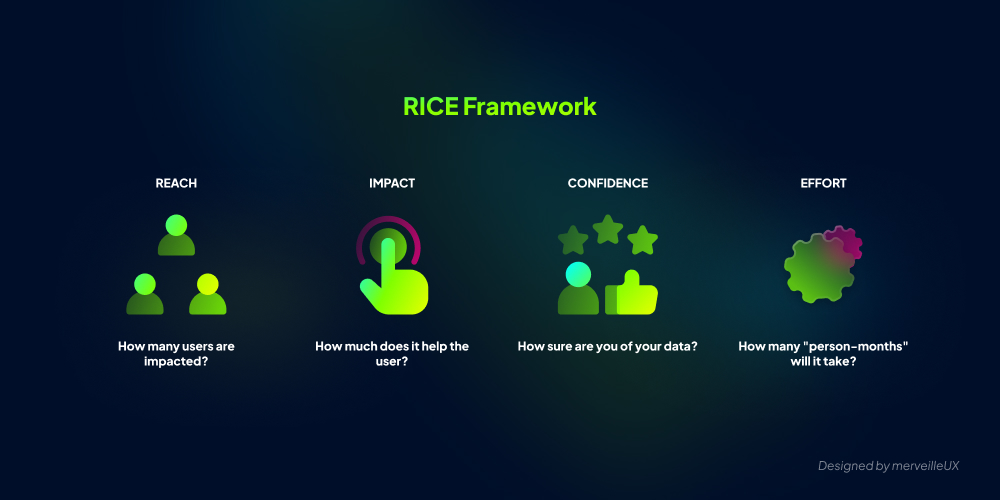
The RICE Framework: Mathematical Rigor
- Reach: How many users will be impacted over a given period?
- Impact: How much will this help the user? (Massive = 3, Medium = 1, Low = 0.5).
- Confidence: How sure are you of your estimates? (100%, 80%, 50%).
- Effort: How many "person-months" will it take?
- Calculation: (Reach x Impact x Confidence) / Effort = RICE Score.
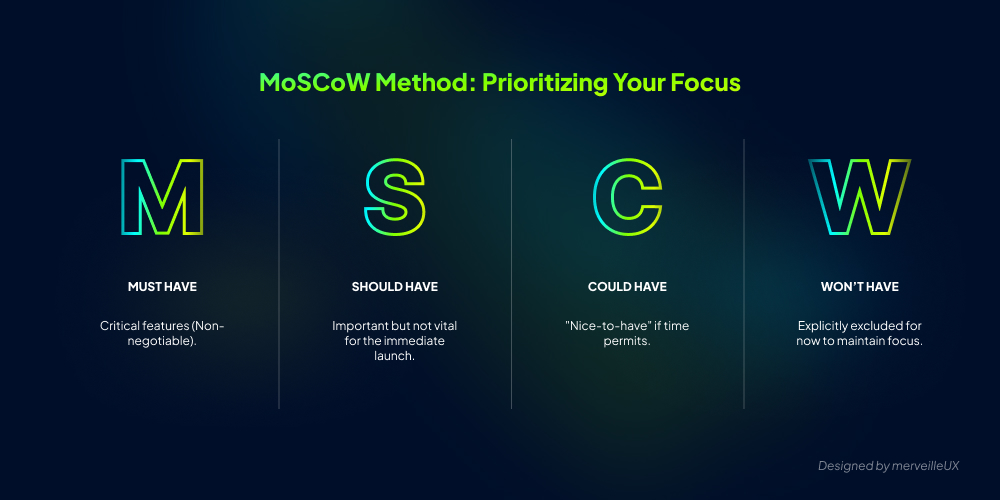
The MoSCoW Method: For MVPs and Launches
- Must have: Vital. Without this, the product is useless.
- Should have: Important but not immediately vital.
- Could have: "Nice to have." If we have time at the end of the sprint.
- Won't have (this time): We consciously decide not to do it now. This is the most important category for protecting your focus.
Pitfalls to Avoid (Or How Not to Sabotage Your Growth)
The "Feature Factory" Trap
This is the syndrome of shipping for the sake of shipping. You deliver, deliver, deliver. But no one asks if the overall UX remains coherent. The result? A bloated, complex application and an overwhelmed customer support team.
Problems vs. Features
- Feature Approach: "Add a search bar."
- Problem Approach: "Allow users to find an invoice in less than 3 seconds." By formulating the problem, you allow the Design team to propose innovative solutions (filters, smart sorting, AI) rather than just sticking an ugly text field at the top of the page.
Managing Technical and UX Debt
If you don't allocate 20% of your roadmap to maintenance and improving the existing product, it will eventually collapse under its own weight. UX erodes over time (visual bugs, journeys that become illogical with the addition of new functions). You need to "clean" the roadmap regularly.
Roadmap Management Tools: 2025 Comparison
- Productboard: The leader. Ideal for centralizing customer feedback and linking it directly to your strategic goals. Very powerful for mature Product teams.
- Harvestr: An excellent alternative for closing the loop between Customer Success, Product, and Engineering.
- Linear: If your team is very "Engineering-heavy," Linear has become the standard for its speed and clarity, although it is closer to a backlog than a macro roadmap.
- Figma: Yes, Figma. To create ultra-visual "Vision Roadmaps" that make investors' eyes light up during fundraising rounds. That’s where we come in to bring your future to life.
The Impact of UX Design on Your Roadmap
Too often, UX is seen as a "coloring" step at the end of the process. This is a major strategic error. An UX-Driven Roadmap approach allows you to:
- Validate before coding: High-fidelity prototyping allows you to test a roadmap feature before writing a single line of code. Cost of a design change: $100. Cost of a dev change: $10,000. The math is simple.
- Reduce technical support: An intuitive interface removes items from your roadmap like "bug fixes" or "minor improvements."
- Improve perceived value: Sometimes, a small improvement in the flow of an existing journey (Onboarding) has more impact on growth than a massive new feature.
Conclusion
A product roadmap is not an end in itself; it is a navigation tool. It should reflect your ambition and guarantee the quality of your product. In an ultra-competitive software market, the difference is no longer made by the number of features, but by their relevance and the quality of their execution.
At merveilleUX, we support software publishers in transforming these strategic intentions into memorable interfaces. We help them prioritize, visualize, and stabilize.
Feel like your roadmap is stalling? Do you feel like you're delivering a lot for very little business impact? It might be time to take a step back. A complete UX Audit often allows you to redefine your roadmap priorities based on field reality rather than assumptions.