



Choosing your pricing model is arguably the most defining decision in a SaaS lifecycle. Yet, it's too often made based on guesswork or by blindly mimicking the competition. You don't choose between monthly subscriptions, credits, or annual plans just for show; you do it to align your business model with your customers' growth. A pricing strategy disconnected from the user’s perceived value is the leading cause of silent churn. In this guide, we move beyond the visual interface to dive into the engine of your profitability: how to define a price structure that fuels your MRR goals without becoming a bottleneck for acquisition.
Table of contents
- 1. Why SaaS Pricing is the Foundation of Your Product Strategy
- 2. Monthly vs. Annual Subscription: Cash vs. Commitment
- 3. Credit / Consumption Model: Finally a Fair Technical Pricing
- 4. Freemium and Free Trial: Stop Giving Away for Nothing
- 5. "Full Price" Purchase (License): The Return of the Tangible
- 6. Specific Models: White Label and Custom Pricing
- 7. The 4 Pillars to Validate Your SaaS Pricing Structure
- 8. Adapting Your SaaS Pricing Over Time: The Art of the Pricing Pivot
- Conclusion
1. Why SaaS Pricing is the Foundation of Your Product Strategy
SaaS pricing isn't the finish line; it's the core contract. Treat it as just a price tag, and you'll miss out on your most powerful segmentation lever: strategic pricing. It’s the tool that defines who your ideal customer is and how you will grow alongside them.
The Value Metric: The unit that (finally) justifies payment
Stop charging for features nobody uses. Find what your customers are actually buying. Is it time saved? Storage? Additional revenue generated via your platform? The "Value Metric" is the measurement unit that aligns your success with your user's success.
| Value Metric | Why it works? | Example |
|---|---|---|
| Per User | Simple to understand, predictable. | Slack, Microsoft 365 |
| Per Usage | Aligned with the client's actual costs. | AWS, SendGrid |
| Per Revenue | The client pays when they earn. | Stripe, Shopify |
- Examples: A marketing click (Hubspot), an active user (Slack), or a GB of storage (Dropbox).
- The problem: If you charge per project while the client makes a living based on the number of contacts, you create unnecessary frustration and a barrier to usage. You want the client to use your product more often, not to be wary of it.
The merveilleUX take: A good value metric must be crystal clear. If a client needs a calculator to understand their bill or has to anticipate hidden fees, your pricing has failed. Clarity beats complexity every time.
Value/Price Mismatch: The "Per Seat" Pricing Trap
Charging per user is the easy way out for SaaS pricing. It’s the default standard, but it’s also often a major strategic error that poisons your organic growth.
- The sabotage: In a collaborative tool, charging per seat is like punishing the client who wants to evangelize your product internally. Every new guest becomes a cost. The result? Teams share login codes, and you lose visibility and security.
- The alternative: Hybrid or usage-based models allow for open access across the entire company while billing based on actual consumption. This model enables viral adoption without immediate budgetary friction.
Impact on MRR and LTV: The Accounting Reality
Your pricing mathematically dictates your revenue ceiling and the health of your business model:
- MRR (Monthly Recurring Revenue): Granular, usage-based pricing allows for automatic revenue expansion without sales intervention. If the client uses more, they pay more. It’s the most powerful lever for exponential growth.
- LTV (Lifetime Value): Unclear pricing or pricing disconnected from perceived value causes churn to skyrocket. If users feel they are paying for "ghost seats" or useless options, they will cancel at the first opportunity.
2. Monthly vs. Annual Subscription: Cash vs. Commitment
The choice between monthly and annual billing isn't a gift you give to the client; it’s a risk calculation for your SaaS pricing and a way to manage your cash flow.
Psychology: Fear of Commitment vs. The Carrot
| Frequency | Customer Advantage | Business Advantage |
|---|---|---|
| Monthly | Total flexibility, low-cost testing. | Reduces the barrier to entry. |
| Annual | Savings (often 2 months free). | Immediate cash flow, reduces churn. |
Monthly is the safety net for the undecided. It lowers the psychological barrier to entry. Annual is about investment and loyalty. Those "2 months free" aren't a generous discount out of nowhere; they are the price you pay to guarantee 12 months of retention and total financial predictability.
Cash Flow: Financing Acquisition Without Begging
For a CEO, annual pricing is a blessing. Collecting 12 months of revenue on Day 1 allows you to cover the CAC (Customer Acquisition Cost) instantly. Instead of waiting 6 or 8 months for a customer to become profitable, you have the cash immediately to reinvest in marketing or development.
Friction: Managing Renewals Without Creating Detractors
Involuntary churn (e.g., expired cards) is the enemy of monthly billing. On annual plans, the risk is "surprise churn": the customer who sees $2,000 debited after a year of forgetting and demands an immediate refund while complaining on LinkedIn.
The merveilleUX take: Don’t play guessing games with renewals. Notify your customers 30 days before the annual charge. Using "dark patterns" to hide the cancellation button is a lazy practice that destroys your brand LTV faster than a major bug.
3. Credit / Consumption Model: Finally a Fair Technical Pricing
The "open bar" subscription era is over for those with real and variable server costs. Usage-based pricing SaaS marks a return to the economy of reality.
Usage-based pricing: Why AI is Unforgiving
The explosion of generative AI has made the classic flat-rate model dangerous. Each request has a high marginal cost (tokens, GPU power). Charging a fixed amount of $20 to a user who consumes $50 in API resources is financial suicide on a large scale. Pay-as-you-go pricing aligns your revenue with your infrastructure bills.
Meter Stress: The Enemy of Usage and Adoption
Beware of "click anxiety." If users feel like every action costs them money in real-time, they eventually self-censor and stop using your product.
- The solution: Don't bill to the nearest penny in real-time. Sell credit packs or use tiers. It’s more psychological, less stressful, and secures your cash flow since credits are often prepaid.
Scalability: The Infrastructure Behind Your SaaS Pricing
For a CTO, usage-based pricing is a major engineering challenge. It's no longer enough to know if a user is "online"; you must track, aggregate, and report every action in real-time to bill without errors.
- Observability and Metering: Implement an ultra-robust metering system. A counting error in your pricing means either your margin melts (under-billing) or your client feels robbed (over-billing). The integrity of billing data is as important as the product code itself.
4. Freemium and Free Trial: Stop Giving Away for Nothing
Choosing between unlimited free access and a time-limited trial is a purely mathematical decision, not a philosophical one.
Freemium: Growth Lever or Financial Sinkhole?
Freemium is a powerful marketing tool to become a market standard (think Notion or Canva). But it’s a trap if your conversion rate is ridiculous. If 99% of your users enjoy free pricing for life without ever considering upgrading, you aren't running a SaaS; you’re running a charity funded by your investors.
Free Trial: The Urgency to Prove Value (Time-to-Value)
The "Free Trial" (7, 14, or 30 days) is a race against time. The user must experience a "Wow" effect and get a concrete result before the payment wall goes up. If your onboarding is laborious or your product requires 3 weeks of configuration, a 7-day trial is a death sentence.
The Strategic "Paywall": Encouraging Upgrades Without Frustration
The paywall should not be perceived as a wall that blocks, but as a door to a higher level of success.
- Feature-based limitation: Ideal for separating individual use from collaborative or Enterprise use (SSO, audit logs).
- Volume-based limitation: The fairest. "Liked our first 10 free analyses? To scale up, here is our pricing."
5. "Full Price" Purchase (License): The Return of the Tangible
SaaS is not a universal religion. In some sectors, the permanent subscription model fatigues buyers, or worse, becomes an unacceptable security risk.
Why it still reassures CFOs and Enterprise Accounts
Paying once (CAPEX) is sometimes easier to fit into an annual investment budget than seeing an operating expense (OPEX) line grow unpredictably every month. For "On-premise" installations (local servers), the perpetual license coupled with a maintenance contract remains a massive selling point.
The "Anti-SaaS" Sectors by Necessity
If your target is in one of these fields, forget "Cloud First" at all costs:
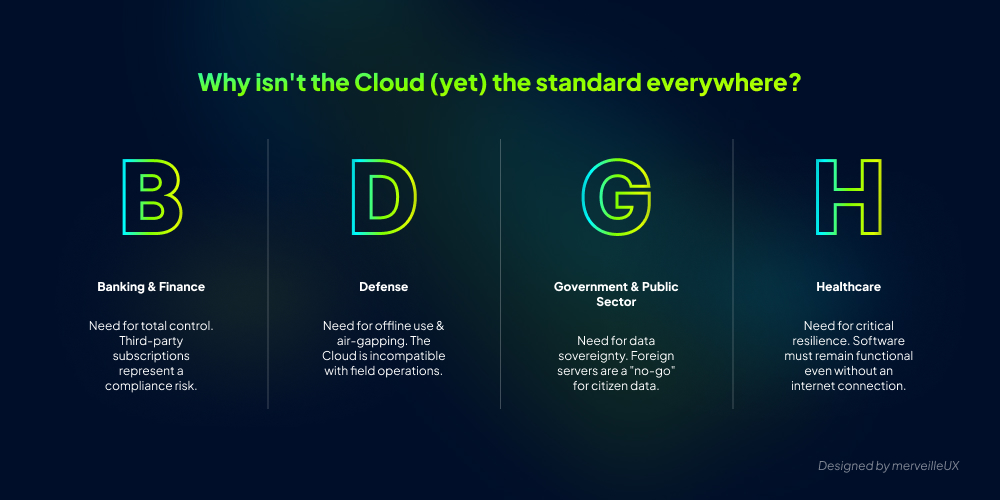
- Banking & Finance: Absolute data control and compliance (GDPR, audits) drive banks to prefer solutions hosted on their own servers (sometimes air-gapped) to avoid any leaks to third parties.
- Defense & Military: Here, SaaS is often strictly forbidden. Software used in the field cannot depend on an internet connection or an external server based abroad. Lifetime licenses on hardened hardware are the norm.
- Government & Public Administrations: For reasons of digital sovereignty, many ministries refuse to store citizen data on foreign private infrastructures. They demand solutions they can own and audit themselves.
- Healthcare & Hospitals: The criticality of health data imposes resilience that the public Cloud doesn't always guarantee according to local standards. Operating room software must work even if the fiber is cut.
The merveilleUX take: Don't see On-premise as a technical regression. It's a high-end niche. If you sell to these sectors, your pricing must reflect this exclusivity: high setup fees + License + 20% annual maintenance. That’s heavy cash—take advantage of it.
6. Specific Models: White Label and Custom Pricing
There is revenue beyond the standard subscription. Sometimes, a single "specific" contract can bring in as much as 1,000 small subscribers.
White Label: Valorizing Technology for Resellers
If your product is a technological building block, allow others to resell it under their own identity. Charge via an entry fee (Setup fee) and revenue sharing. It’s the fastest way to conquer adjacent markets without having to manage final customer support.
Custom Development: The Risky High-End
Agreeing to develop specific features for a large client can fund your R&D. But beware the trap: if you start maintaining different code branches for each client, you destroy your technical scalability and turn your SaaS into a disguised service agency.
7. The 4 Pillars to Validate Your SaaS Pricing Structure
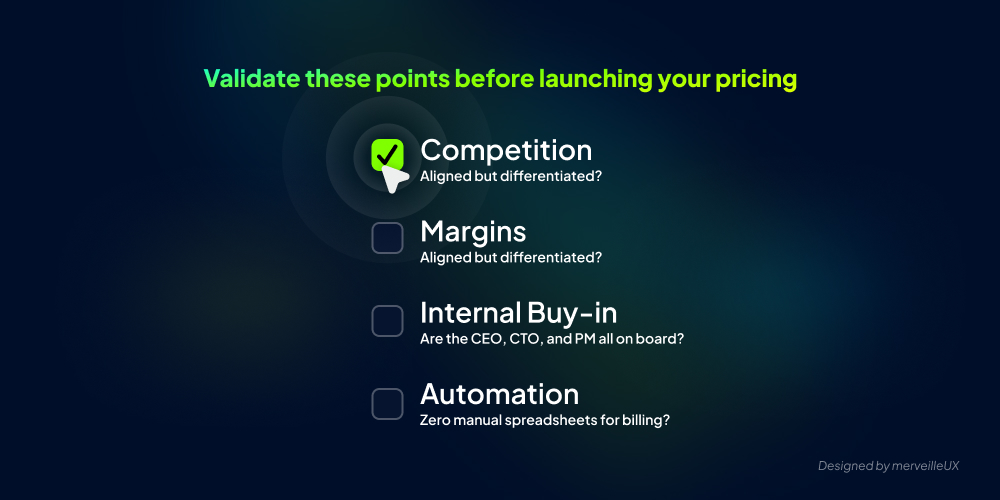
Before launching or modifying your grid, run your hypotheses through these four realities:
- Competition: Don’t copy them, but understand their anchors. Being $1 cheaper isn't a strategy; it's a commodity play that pulls you down.
- Margin (COGS): Know your "Cost of Goods Sold." Hosting, support, third-party APIs, bank fees... If you don’t know your gross margin per price segment, you’re flying a plane without a dashboard.
- Internal Alignment: Pricing must satisfy the CEO (growth and MRR), the CTO (technical feasibility of metering), and the Product Manager (adoption and retention). If one of the three drags their feet, the model will fail.
- Automation: If your sales or accounting team has to spend days on Excel calculating invoices or managing prorations, your billing system is prehistoric. Invest in tools like Stripe Billing or Chargebee as soon as possible.
8. Adapting Your SaaS Pricing Over Time: The Art of the Pricing Pivot
Your pricing is not a marble statue; it’s a working hypothesis that must evolve.
- Grandfathering: This is the golden rule for increasing prices without causing a riot. Keep old rates for your loyal customers and apply new rates only to new customers. This reduces churn and rewards seniority.
- Signals for Change: If your infrastructure costs are rising faster than your revenue, or if you notice customers intentionally limiting their usage to avoid moving to a higher tier, your SaaS pricing is a bottleneck. Change it before it’s too late.
Conclusion
Automating broken processes doesn't make them better; it just makes them fail faster. Your SaaS pricing is a living organism that reflects the value you bring to the world. If it generates more support tickets than lines in your bank account, it’s time to stop the bleeding, step back, and review your strategy.
Discover how our mockup and prototype services can bring your ideas to life! Explore our full range of design solutions and let our experts create custom mockups for your business. Ready to turn your concepts into reality?